Band shapes in UV/Visible spectra: Franck-Condon Principle
Let us consider an electronic transition from state to state . The intensity of the pure electronic transition is governed by the transition dipole moment :
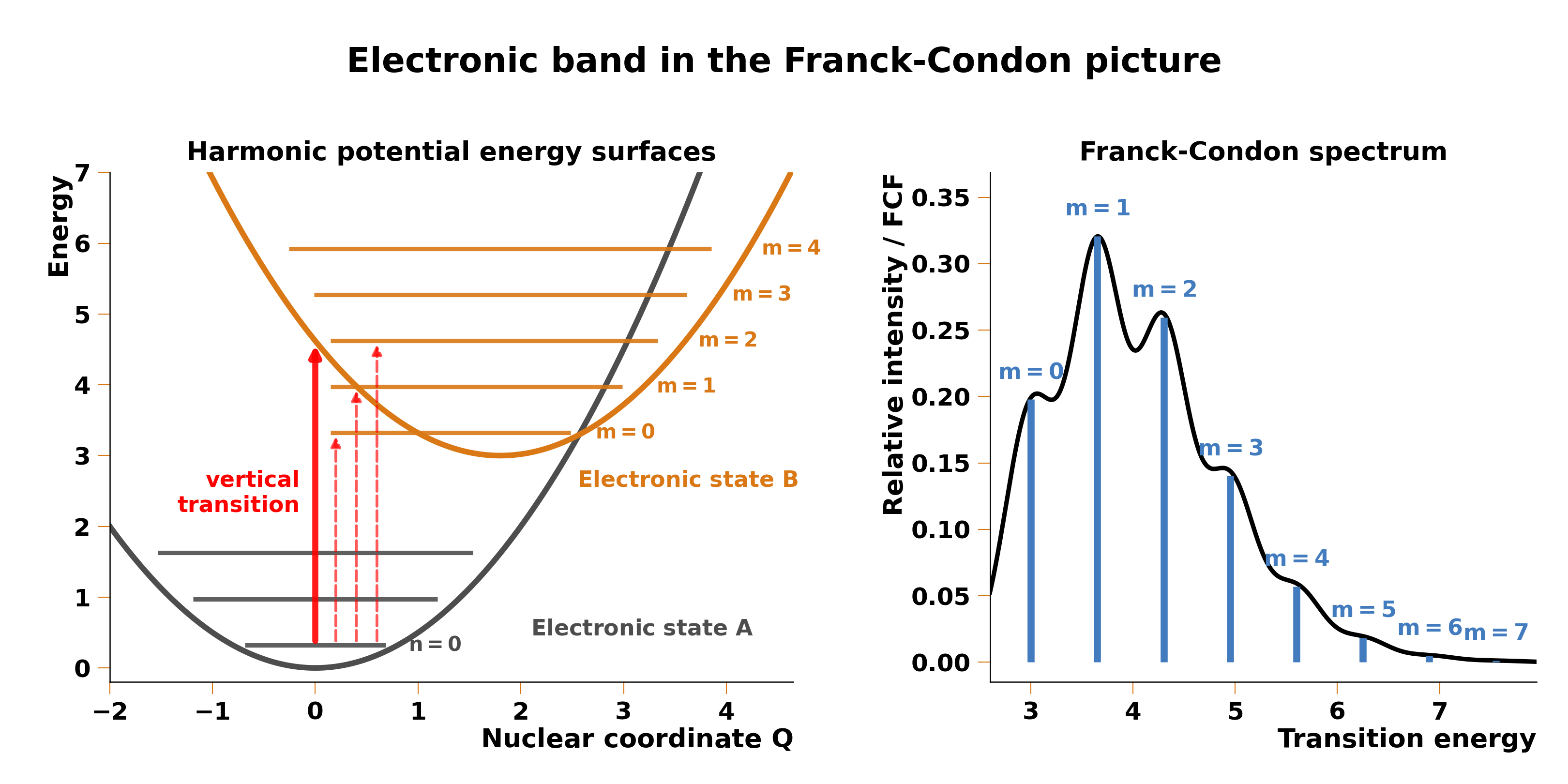
In reality, electronic transitions are accompanied by changes in the vibrational state of the molecule (vibronic transitions). Assuming only transitions from the ground vibrational state of electronic state , , (i.e., zero temperature) the intensity of vibronic transition from to is in the first approximation:
where is the electronic transition dipole moment, whereas is the Franck-Condon factor equal to the overlap of the vibrational wave functions in different electronic states. Thus an electronic band (for example in the UV/Visible absorption spectrum) consists of vibronic lines, which may or may not be resolved in the experiment. This shape is in general asymmetric unlike Lorentz and Gauss profiles.
References
- Franck, J. & Dymond, E. G. "Elementary processes of photochemical reactions," Trans. Faraday Soc. 21, 536-542 (1926). DOI: 10.1039/TF9262100536
- Condon, E. U. "A theory of intensity distribution in band systems," Phys. Rev. 28, 1182-1201 (1926). DOI: 10.1103/PhysRev.28.1182