Linear Coupling Model (LCM)
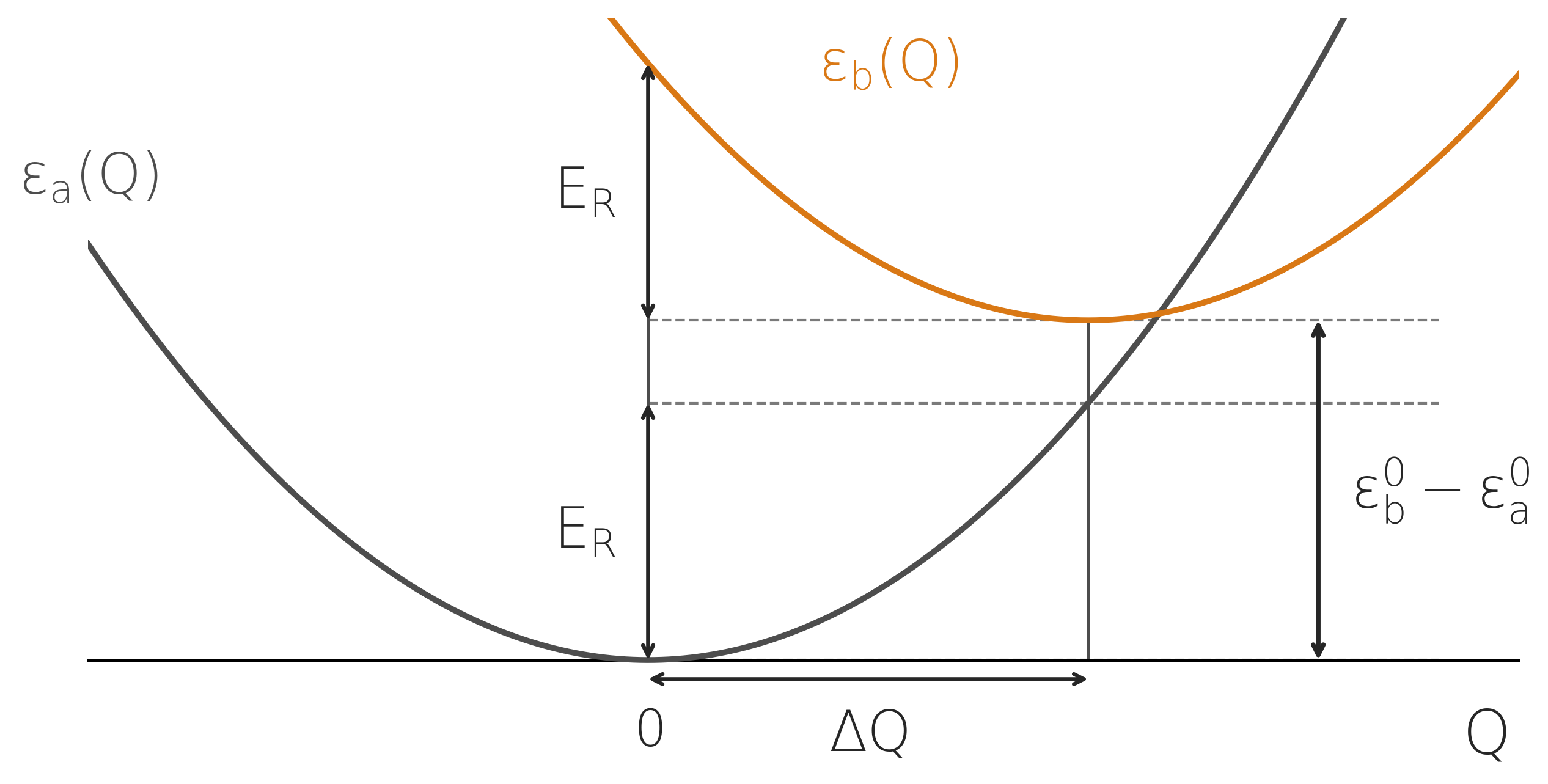
The Linear Coupling Model relates excited-state gradients to vibronic coupling. It assumes that vibrations in the electronically excited states have the same frequencies and normal modes and only differ by the origin shift (displacement).
Theory
Mathematically it means that the excited-state potential energy surface near the ground-state equilibrium geometry is:
where:
- : Excited-state energy at ground-state equilibrium geometry
- : Normal mode coordinates
- : Excited-state gradient at ground-state geometry
- : Ground-state Hessian
Huang-Rhys Factors from Gradients
For each normal mode we define the mode displacement: where is normal mode shift between ground and excited electronic states.
Within the linear coupling model (LC): whereas where:
- : Excited-state gradient projection onto mode
- : Ground-state mode frequency
- : Mode displacement (dimensionless)
- : Huang-Rhys factor (dimensionless)
Physical interpretation of : Huang-Rhys factor is equal to the molecular reorganization energy at vibronic transition expressed in the units of the vibration frequency:
In addition:
- : No vibronic coupling (purely electronic transition)
- : Weak coupling (0-0 transition dominates)
- : Moderate coupling (several vibronic bands visible)
- : Strong coupling (many vibronic bands, red-shifted maximum)
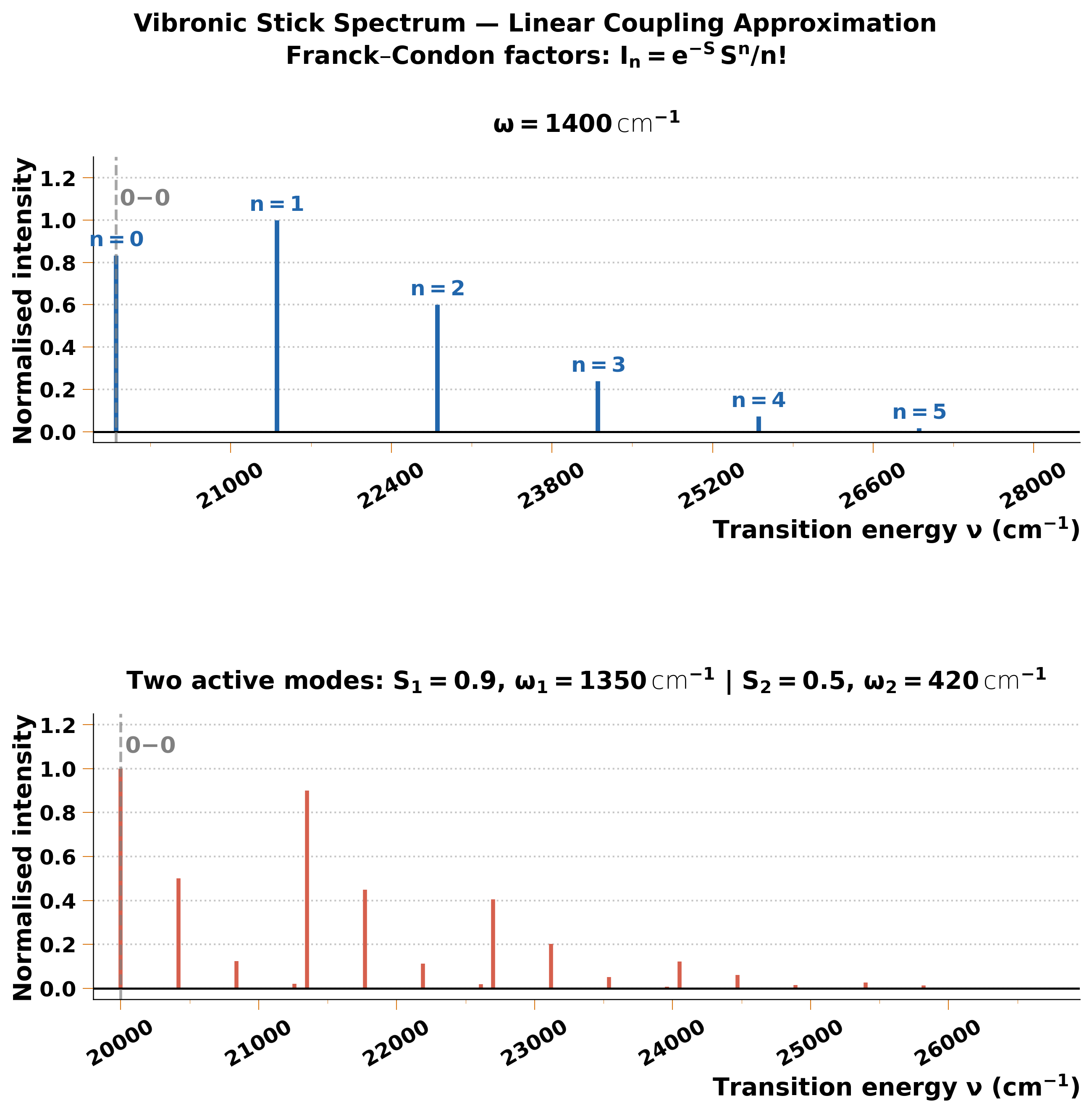
The vibronic profile of an electronic band in the linear coupling approximation follows a Poisson distribution for each mode with non-zero displacement: where is the vibrational state.
For several such active modes the spectrum is a convolution of Poisson distributions.
Computing vibronic profile within the LC model
- Ground state optimization
- Compute Hessian → frequencies and normal modes;
- Excited state gradient at ground-state geometry (vertical);
- Huang-Rhys factors: project Cartesian gradient onto normal modes; and calculate for each mode ;
- Generate spectrum as convolution of Poissonian distributions (Eq. 1).
Advantages
- Computationally efficient: Only need single-point gradient
- Physically motivated: Based on potential energy surfaces
- Mode-specific: Individual for each vibration
Limitations
- Harmonic approximation: Assumes quadratic potentials
- Linear coupling only: Neglects Duschinsky rotation and frequency changes
- Vertical approximation: Simplified geometry relaxation in the excited state
References
- Huang, K. & Rhys, A. "Theory of light absorption and non-radiative transitions in F-centres," Proc. R. Soc. Lond. A 204, 406-423 (1950). DOI: 10.1098/rspa.1950.0184
- Duschinsky, F. "Zur Deutung der Elektronenspektren mehratomiger Moleküle," Acta Physicochim. URSS 7, 551-566 (1937)
- Kupka, H. & Cribb, P. H. "Multidimensional Franck–Condon integrals and Duschinsky mixing effects," J. Chem. Phys. 85, 1303-1315 (1986). DOI: 10.1063/1.451216